.png?prefix=itzana)
When a Hollywood A-lister wants to disappear, they don't go to St. Barts anymore... they go to Belize. The Caribbean's worst-kept secret among the famous-but-tired-of-being-seen is a small English-speaking country tucked between Mexico and Guatemala, a place where private islands are within reach, and a movie star can walk a beach without being recognized.
We at Itz'ana have watched this quiet migration unfold over the past several years. Below, we break down why Belize has become the preferred private Caribbean escape for famous travelers, and what makes it work so well for guests who prize discretion above all else.

The Short Answer: Discretion, Distance, and the Reef
Belize offers three things the rest of the Caribbean struggles to match simultaneously:
- Genuine privacy — small population, low tourist density, no tabloid infrastructure, and an English-speaking culture that makes private staffing seamless.
- Geographic accessibility from the U.S. — direct flights from Houston, Miami, Dallas, Atlanta, Newark, and Los Angeles land in under five hours from most major hubs.
- Natural drama — the Belize Barrier Reef, a UNESCO World Heritage Site and the largest reef system in the Western Hemisphere, plus [ancient Maya sites](Maya sites) and dense jungle within a 90-minute drive of the coast.
In other words, it delivers the seclusion of a remote private island with the convenience of a short-haul flight, and almost none of the celebrity-spotting culture that has overtaken Mustique, St. Barts, and parts of Turks and Caicos.
Who's Been Going (and Why It Stays Quiet)
Leonardo DiCaprio has owned Blackadore Caye, a private island off the Belize coast, since 2005 and is developing it as an eco-resort. The Duke and Duchess of Sussex chose Belize for a Commonwealth tour stop. Cameron Diaz, Matt Damon, and Kim Kardashian have all been photographed, discreetly, vacationing in the country. Madonna famously wrote "La Isla Bonita" about a Belizean cay.
What's notable is what doesn't happen after these visits: there are no follow-up tabloid spreads, no "spotted at" gossip cycles, no Instagram geotag floods. The Belizean tourism culture is quietly protective. Resort staff are trained, and culturally inclined, toward discretion. There is no domestic paparazzi industry. Locals tend to leave guests alone.
The Five Reasons High-Profile Travelers Are Choosing Belize Right Now
1. The Privacy Architecture Is Built In
In St. Barts during high season, a celebrity guest is essentially performing in public. In Belize, the geography itself protects you. The [Placencia peninsula](Placencia peninsula) — a 16-mile sliver of sand on the southern coast, is reached by a single road or short hop on a Cessna. [Private villas, gated residential resorts](private villas), and offshore cays mean a guest can spend a week without crossing paths with another traveler unless they choose to.
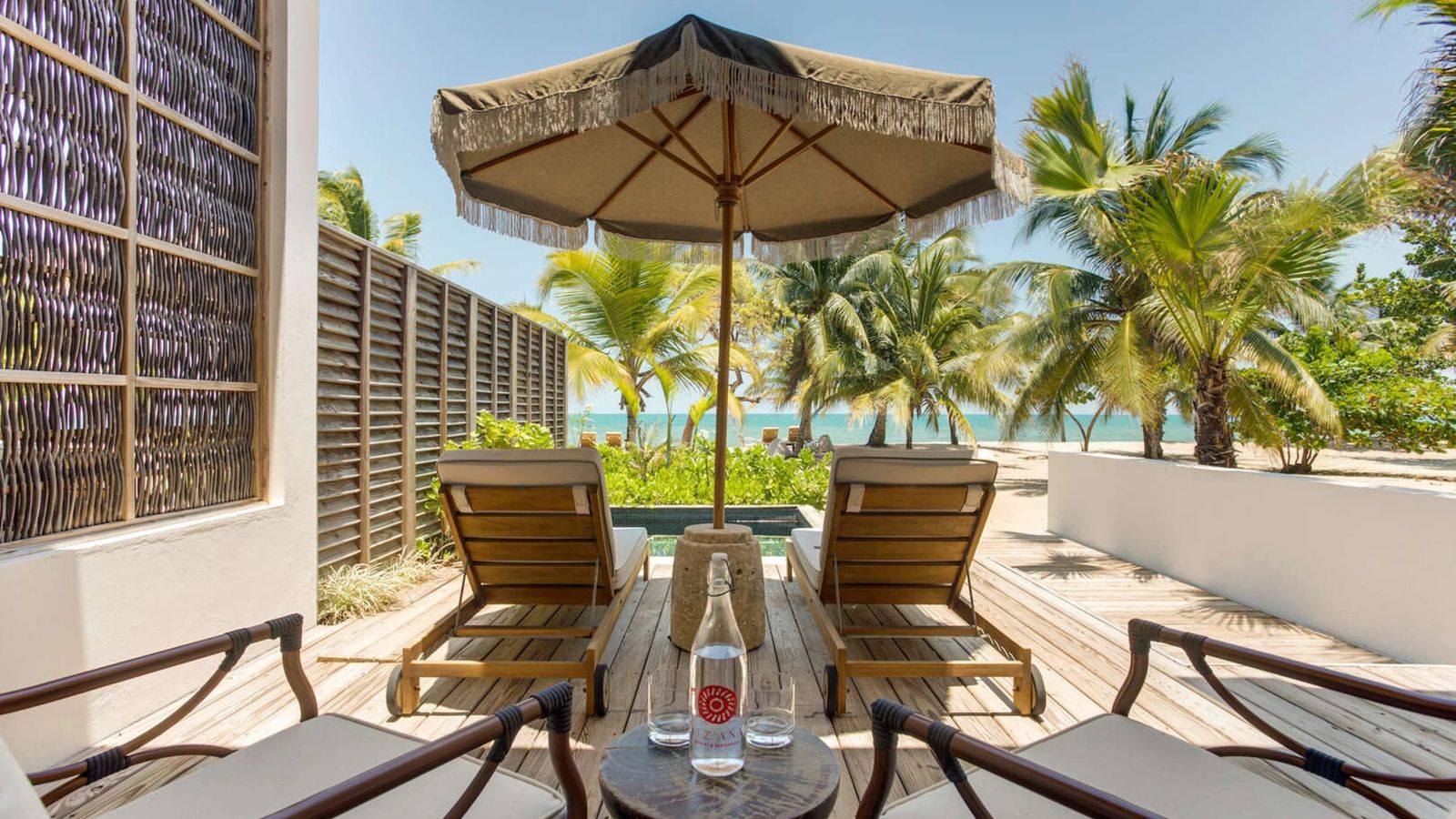
At Itz'ana, our beachfront villas and hotel suites are designed for indoor-outdoor living with private plunge pools, walled gardens, and direct lagoon or beach access, so a guest never has to leave their footprint to enjoy the water, the sun, or a meal.
2. Authentic, Not Manufactured, Luxury
Discerning travelers have grown tired of the homogenized Caribbean: the same imported marble lobbies, the same overworked beach club DJs, the same brand-name boutiques. Belize offers something different. Architecture here uses local hardwoods, thatch, and lime-washed stone. Cuisine draws on Maya, Garifuna, Creole, and Mestizo traditions, fresh cacao, recado rojo, hudut, fire-hearth-cooked snapper.
Sister-property thinking helps the country as a whole: boutique resorts like Kaana in the Cayo District and Itz'ana on the coast have collectively built an ecosystem where guests can experience jungle and reef in a single trip without sacrificing the standard of service they expect.
3. Two Bucket-List Ecosystems in One Country
Few destinations let a guest dive a UNESCO reef in the morning and explore a 1,300-year-old Maya temple in the afternoon. Belize does. The Great Blue Hole, Caracol, Xunantunich, Actun Tunichil Muknal (the ATM cave), and the largest cave system in Central America are all within day-trip range of the Placencia coast.
This matters for high-profile guests for a specific reason: it satisfies the desire for meaningful travel. A vacation becomes a story worth telling, not just another beach week.
| Experience | Distance from Placencia | Best For |
|---|---|---|
| Belize Barrier Reef snorkel/dive | 20–45 min by boat | First-day arrivals, families |
| Cockscomb Basin Jaguar Preserve | 1 hour by car | Adventure travelers |
| Nim Li Punit Maya ruins | 45 min by car | Half-day cultural excursion |
| Monkey River jungle expedition | 30 min by boat | Wildlife enthusiasts |
| Silk Cayes private island picnic | 60 min by boat | Couples, romantic days |
4. The Logistics Actually Work
A common misconception is that Belize is hard to reach. It isn't. Philip S. W. Goldson International Airport (BZE) outside Belize City receives direct flights from major U.S. carriers including United, American, Delta, Southwest, and Alaska. From BZE, a 35-minute domestic flight on Tropic Air or Maya Island Air drops guests at the Placencia airstrip. For private aviation, the country accommodates G450s, Globals, and similar at BZE, with handling and customs clearance arranged in advance.
For our highest-profile guests, we coordinate private arrivals end-to-end, from tarmac transfer to resort entrance, so the public-facing portion of the journey is essentially invisible. This is detailed in our Privacy & Discretion guidelines for high-profile guests.
5. English Is the Official Language
This is more important than it sounds. Belize is the only English-speaking country in Central America, a legacy of its time as British Honduras. For American and British travelers, and especially for guests traveling with security teams, assistants, and family, the linguistic ease removes friction at every interaction: customs, drivers, staff, doctors, vendors. There's no translation lag, no cultural misreading, no awkward staff dynamic.
How Belize Compares to the "Usual" Celebrity Escapes
| Factor | Belize | St. Barts | Turks & Caicos | Mustique |
|---|---|---|---|---|
| Paparazzi presence | Virtually none | High in season | Moderate | Low |
| Direct U.S. flights | Yes (5 hrs from most hubs) | Limited; usually via St. Maarten | Yes | No (private only practical) |
| Language | English | French | English | English |
| Beyond-beach experiences | Reef, jungle, Maya ruins | Limited | Limited | Limited |
| Tourist density | Low | Very high (Dec–Feb) | High | Low (members only) |
| Avg. luxury room rate | $$$ | $$$$$ | $$$$ | $$$$$ |
For a more detailed breakdown, see our editorial on Belize vs. Turks and Caicos and why travel insiders are skipping the crowded Caribbean for Belize.
The Reef, Up Close
We'd be remiss not to talk about what most guests come for: the water. The Belize Barrier Reef stretches roughly 190 miles along the coast and includes three of the four atolls in the Western Hemisphere. Visibility regularly exceeds 100 feet. Whale shark encounters happen seasonally off Gladden Spit (March–June).
Whether you're a first-time snorkeler or a certified diver looking for advanced wall dives, the reef accommodates both. We cover this in depth in our guides on the Belize Barrier Reef and snorkeling vs. diving.
Planning a Visit
Belize requires no visa for U.S., U.K., Canadian, EU, and most Commonwealth passport holders for stays under 30 days. The dry season runs February through May; the green season (June through November) brings lower rates and the country's most dramatic skies. December and January are peak, book six to nine months ahead for villa availability.
A full planning resource is available in our 2026 Belize Travel Planning Guide, covering flights, weather windows, packing, and seasonal considerations.